
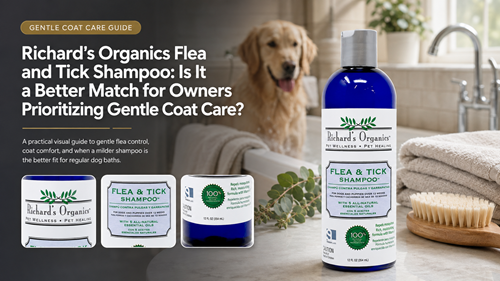
Richard’s Organics Flea and Tick Shampoo is positioned around botanical and essential-oil ingredients, which can appeal to owners who prioritize a gentler-feeling coat-care routine. “Natural” or botanical positioning, however, does not guarantee that a dog will tolerate the formula or that the product should be used more freely than another flea-and-tick shampoo.
Owners should read the full ingredient list, species and age directions, pest claims, contact time, rinse instructions, and sensitivity warnings before use. Essential oils can be biologically active, and dogs with allergies, inflamed skin, chronic dermatologic disease, or a history of reactions deserve extra caution.
The most useful comparison is not natural versus chemical as a simple binary. It is whether this exact shampoo fits the dog’s pest-control need, coat type, skin history, bathing frequency, and the rest of the household parasite plan.
When Richard’s Organics Flea and Tick Shampoo Fits a Coat-Care Priority
A coat-focused owner may prefer a shampoo that is marketed around botanical ingredients and a non-drying grooming experience, especially when the dog already receives regular baths. That preference should still sit under the product label, because flea-and-tick shampoos are used for a pest-control purpose rather than simply for fragrance or coat softness.
SynergyLabs identifies Richard’s Organics as a brand that uses essential oils. Those ingredients deserve the same careful review as any other active or fragrance component, particularly around dogs with sensitive skin or in multi-pet homes where another species may contact a wet coat.
Evaluate Gentle-Coat Claims Without Skipping Pest-Control Safety
Start with the Exact Richard’s Formula
A gentle flea shampoo for dog coats comparison should begin with the exact product listing and current bottle label rather than with the brand name alone.
Different Richard’s or SynergyLabs products can use different ingredients and directions. Match the label to the bottle actually being used.
Read Every Botanical and Essential-Oil Ingredient
A natural active dog pest shampoo can contain multiple plant-derived ingredients, so owners should review the full list for known sensitivities instead of treating “natural” as one ingredient.
If the dog has reacted to scented grooming products before, discuss the formula with a veterinarian before use and avoid adding other fragranced products in the same bath.
Judge Dryness After the Coat Is Fully Dry
A non drying flea bath formula should be judged several hours after rinsing, when the coat and skin can be evaluated without water or conditioner masking the result.
Watch for tight flaky skin, increased scratching, redness, or licking. Bath water temperature and frequency can contribute to dryness even when the formula is marketed as gentle.
Verify Mosquito Claims on the Current Label
A mosquito repelling dog shampoo option should be compared by the exact labeled pests and duration, not by assuming every flea shampoo also provides meaningful mosquito control.
Outdoor dogs still need a broader veterinarian-guided prevention plan and should not rely on one bath for ongoing mosquito or tick protection.
Botanical Grooming Still Needs a Full Rinse
A botanical flea grooming wash should be lathered and rinsed exactly as directed, with particular care around eyes, nose, mouth, and any irritated skin.
Do not leave extra residue on the coat in the hope that botanical ingredients will last longer. Follow label contact and rinse instructions.
Coat-Friendly Means the Dog Remains Comfortable
A coat friendly tick shampoo decision should compare pest-control needs with the dog’s normal sensitive-skin grooming routine.
If a dog requires frequent medicated or dermatology baths, ask the veterinarian how flea-shampoo use fits that treatment schedule rather than alternating products without a plan.
Botanical Flea-Shampoo Buying Questions
Use these questions to compare formula fit instead of choosing by the word natural alone.
| Question | Why It Matters | What to Verify |
|---|---|---|
| What ingredients create the pest claim? | Botanical does not mean inactive | Full label and manufacturer directions |
| Is fragrance or essential oil included? | Sensitive dogs may react | Complete ingredient list |
| How often can it be repeated? | Over-bathing can irritate coat and skin | Product-specific interval |
| Which pests are actually listed? | Claims vary by formula | Current front and back label |
| Does the dog have skin disease? | Existing inflammation changes tolerance | Veterinary advice before use |
Use the First Bath as a Tolerance Check
Before the first bath, photograph any existing dry or itchy areas so post-bath changes are easier to judge. Brush the dog, prepare a timer and towels, and follow the label without adding essential oils or home remedies to the shampoo.
After drying, inspect the neck, belly, armpits, groin, feet, and areas the dog tends to lick. Record whether the coat feels comfortable and whether scratching changes over the next day.
Gentle-Coat Bath Checklist
- Read complete ingredient list
- Confirm dog meets age and health directions
- Review known fragrance or botanical sensitivities
- Inspect skin before bathing
- Follow dilution and contact instructions
- Prevent eye and mouth exposure
- Rinse thoroughly
- Dry without aggressive rubbing
- Monitor coat and skin after the bath
If the dog repeatedly becomes dry or itchy after flea shampoos, the right response may be a different prevention strategy rather than another “gentler” shampoo.
Natural Positioning Does Not Remove Adverse-Reaction Risk
Stop use and contact a veterinarian if the dog develops hives, swelling, marked redness, vomiting, weakness, tremors, breathing difficulty, or another concerning reaction. Keep the bottle and ingredient list for reference.
Avoid adding concentrated essential oils to a pet shampoo. Dogs and other household pets can have species-specific sensitivities, and the finished manufacturer formula should be used only as directed.
SynergyLabs’ manufacturer help center identifies Richard’s Organics as one of its brands and notes that essential oils are used in Richard’s Organics formulations; that makes current label review important for sensitive dogs.
Choose Richard’s Organics Flea and Tick Shampoo by Formula Fit, Not the Natural Label
Richard’s Organics Flea and Tick Shampoo can appeal to owners who want flea-and-tick bathing to align with a coat-care preference, but botanical marketing should not override label directions, ingredient review, or skin observation.
The best fit is a dog that needs the labeled pest-control bath, tolerates the formula, and has a broader prevention plan that does not depend on frequent shampooing alone.
Frequently Asked Questions
Does natural mean this shampoo cannot irritate a dog?
No. Botanical and essential-oil ingredients can still cause irritation or sensitivity in individual dogs.
Can I add my own essential oils to the bath?
Avoid modifying the formula. Use the finished product only as directed and ask a veterinarian before adding other active ingredients.
Is this a regular grooming shampoo for every bath?
Use it according to its flea-and-tick label and actual pest-control need rather than automatically using it for every routine bath.
What should I check after the first bath?
Look for redness, increased scratching, dry flaky skin, licking, swelling, or behavioral changes after the coat is dry.
What if my dog already uses a topical flea product?
Review both labels and ask a veterinarian how shampoo use should be timed with the topical treatment.
